Showing posts with label military. Show all posts
Showing posts with label military. Show all posts
Tuesday, February 07, 2012


Saturday, February 02, 2008
Your Pre-Super-Bowl Reading
From around the web:
- Via Brad DeLong, James Fallows follows the money in U.S./China trade, so you can, too.
- Greg Mankiw lets New Hampshire Senate candidate Jay Buckey into the Pigou Club for proposing a gas tax of roughly 7 cents per gallon at current prices. Read about the National Security Levy here. It's as good a place as any for an aspiring politician to start.
- Closer to home, Dartmouth's president, Jim Wright, will receive the Semper Fidelis Award from the Marine Corps Scholarship Foundation for his work on behalf of wounded veterans. Read more here.
Tuesday, August 14, 2007
The Counterinsurgency 411
Former Marine Captain Nathaniel Fick gives us an ominous welcome in Sunday's Washington Post Outlook:
Read the whole thing. Follow it up with some Q&A.
Welcome to the paradoxical world of counterinsurgency warfare -- the kind of war you win by not shooting.
The objective in fighting insurgents isn't to kill every enemy fighter -- you simply can't -- but to persuade the population to abandon the insurgents' cause. The laws of these campaigns seem topsy-turvy by conventional military standards: Money is more decisive than bullets; protecting our own forces undermines the U.S. mission; heavy firepower is counterproductive; and winning battles guarantees nothing.
Read the whole thing. Follow it up with some Q&A.
Monday, May 28, 2007
Memorial Day at Dartmouth
Last week, ABC News made the Wright choice for its Person of the Week. To read more about the inspiring work that Dartmouth President Jim Wright has been doing on behalf of severely injured veterans, see this story from The New York Times:
We'll look forward to welcoming Mr. Crist and others to campus in the fall and, as ever, be grateful that we can honor them on Veterans' Day rather than Memorial Day.
When he first met James Wright, the president of Dartmouth College, two years ago, Samuel Crist was in a hospital bed at the National Naval Medical Center in Bethesda, Md., recuperating from gunshot wounds from a firefight in Falluja, Iraq.
“I was pretty heavily medicated, so my memory is a little bit foggy, but he was visiting people and asking about their experiences in the war, and pushing people to get an education,” said Mr. Crist, 22, who grew up in Lafayette, La. “He said he’d been a marine, too, and he’d gone to college after he got out as a lance corporal, the same rank I separated at.”
That hospital visit changed things for both Mr. Crist and Mr. Wright: On Mr. Wright’s advice, Mr. Crist enrolled in college courses in Texas, and next fall, will transfer to Dartmouth.
Mr. Wright, 67, meanwhile, has made eight more visits to wounded veterans at Bethesda and at Walter Reed Army Medical Center in Washington, and, with the American Council on Education, started a program to provide individualized college counseling to seriously injured veterans.
We'll look forward to welcoming Mr. Crist and others to campus in the fall and, as ever, be grateful that we can honor them on Veterans' Day rather than Memorial Day.
Tuesday, November 21, 2006
Drafting with Charlie Rangel
There has been considerable discussion in the blogosphere about the latest installment of Representative Rangel's legislative proposals to reinstate the draft. Some of the discussion has been abetted by Milton Friedman's well publicized opposition to a draft and his recent passing. This is obviously a non-starter in Congress, based on the reactions of the current and incoming leadership. But it's a worthwhile discussion to have.
Of the several varieties of this legislation that Rangel has proposed in the last four years, I am most sympathetic to a version that includes both sexes and a wide age range (like 18 to 42, as in this latest proposal), with essentially no exceptions. If something like this were to be done, it should be done in a manner such that everyone has an equal chance of serving.
However, I don't necessarily subscribe to Rangel's reasoning:
To my mind, the largest problem with the draft is that it puts a lot of untrained people not just in a position to get themselves killed but in areas where they might compromise the safety and mission of the well trained armed forces who would still do most of the work. A commenter (k harris) at Angry Bear put it well:
During these five years, there as been a frustrating absence of Presidential rhetoric about how citizens can participate meaningfully. If militant Islam is now such a threat to our existence as a society, then why are we not encouraged to change our way of life as a society to meet it? Is our patriotic duty as a citizenry really just to keep the economy humming along, so that tax revenues are generated to pay for the military budget? There's little outlet for patriotism in going to the office or the mall. To channel the patriotic fervor into something constructive, we need people to engage in something new, not something routine.
Of the several varieties of this legislation that Rangel has proposed in the last four years, I am most sympathetic to a version that includes both sexes and a wide age range (like 18 to 42, as in this latest proposal), with essentially no exceptions. If something like this were to be done, it should be done in a manner such that everyone has an equal chance of serving.
However, I don't necessarily subscribe to Rangel's reasoning:
"There's no question in my mind that this president and this administration would never have invaded Iraq, especially on the flimsy evidence that was presented to the Congress, if indeed we had a draft and members of Congress and the administration thought that their kids from their communities would be placed in harm's way," Rangel said.One could just as readily make the argument that if we had millions of people available for military service at little additional cost, we would find ways to use them.
To my mind, the largest problem with the draft is that it puts a lot of untrained people not just in a position to get themselves killed but in areas where they might compromise the safety and mission of the well trained armed forces who would still do most of the work. A commenter (k harris) at Angry Bear put it well:
As a matter of rightness, we need to settle on who should serve, on whether service should be compulsory, and on how service should be compensated.The fundamental issue is not a draft but a mass mobilization of the population. In the wake of 9/11, much of the population was willing to be mobilized. Manpower applied to homeland security and the "War on Terror" could have been increased substantially without conscription. We would be five years ahead of where we are now in terms of training the citizenry to resist or respond to attack and to match them to the areas where they could help the most.
Some of those questions also spill over into preparedness, but preparedness goes beyond just those questions. We have been sending accountants and school teachers into a quasi-policing, quasi-combat situation. It's stupid. We have a highly mechanized, highly computerized method of war-making. Grabbing people off the streets, either through conscription or through reserve obligation, and tossing them into the military, is not going to get the job done. It was never a good idea to shove a rifle, or a pike, into a conscript's hands and put him on the battlefield. These days, it is not a good idea to put a conscript or a reservist into the logistics chain or a behind the lines hospital orderly uniform, much less on the battlefield. If we are going to keep fighting battlefield wars, and it looks like we are, then we need to do a better job of matching skills to jobs. That means interrupting people's lives during peacetime, giving them the specialized skills they need, and then turning them loose again. Keep bringing them back to keep skills fresh, in case we need them. That's a shared burden. It also helps keep battlefield soldiers supported in a way that may save lives.
During these five years, there as been a frustrating absence of Presidential rhetoric about how citizens can participate meaningfully. If militant Islam is now such a threat to our existence as a society, then why are we not encouraged to change our way of life as a society to meet it? Is our patriotic duty as a citizenry really just to keep the economy humming along, so that tax revenues are generated to pay for the military budget? There's little outlet for patriotism in going to the office or the mall. To channel the patriotic fervor into something constructive, we need people to engage in something new, not something routine.
Saturday, November 11, 2006
Happy Veterans Day
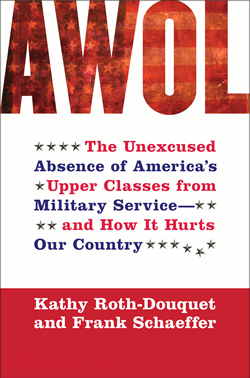 Last evening, the Rockefeller Center commemorated Veterans' Day with a presentation by Kathy Roth-Douquet and Frank Schaeffer of their book, AWOL: The Unexcused Absence of America's Upper Classes from Military Service--and How It Hurts Our Country
 .
.I thought it was a fascinating presentation, and I'm persuaded that the military will not be used as responsibly as it should be as an instrument of diplomacy if it does not include more participation by the upper classes, whom I would define as those with many choices about whether and where to work beyond military service.
I thought they summarized quite well why this situation won't change of its own accord. It is the convenient bargain struck by three institutions--the government, the military establishment, and the upper classes themselves. For the first two institutions, they realize when it's the children and spouses of those in the upper classes risking everything on the battlefield, they are likely to be more vocal in their displeasure with the military and civilian leadership when things go wrong. Who wants that kind of oversight if you can get by without it? And for the upper classes, the narrow benefits are obvious--why risk your neck if someone else will do it for you?
You can read more about the authors project here. It's the beginning of a very important national conversation.
UPDATE: Here's the story in Monday's issue of The Dartmouth.
Wednesday, November 01, 2006
Defying Logic
There is apparently quite a bit of fallout from the following remark made by Senator Kerry on Monday:
Part of the fallout involved this clarification:
Most of the fallout has been criticism of the Senator for saying that members of the armed forces services in Iraq are not smart, despite the clarification.
This fallout is misguided, even focusing on what he said initially. His critics are insisting that the members of the armed forces serving in Iraq are smart. I agree with their assessment, but their examples are not relevant here. These examples falsify the statement:
He didn't say this. He said:
To falsify this statement, you need to find people who are not smart who are not stuck in Iraq. It's very easy to do that as well. You could start with people who don't understand the structure of if-then statements who are stuck in the Senate, if you wanted to.
He said: "You know, education -- if you make the most of it, you study hard and you do your homework and you make an effort to be smart, you can do well.
"If you don't, you get stuck in Iraq."
Part of the fallout involved this clarification:
A Kerry aide said that the prepared statement, which had been designed to criticize Bush, "was mangled in delivery."
Kerry was supposed to say, "I can't overstress the importance of a great education. Do you know where you end up if you don't study, if you aren't smart, if you're intellectually lazy? You end up getting us stuck in a war in Iraq."
Most of the fallout has been criticism of the Senator for saying that members of the armed forces services in Iraq are not smart, despite the clarification.
This fallout is misguided, even focusing on what he said initially. His critics are insisting that the members of the armed forces serving in Iraq are smart. I agree with their assessment, but their examples are not relevant here. These examples falsify the statement:
"If you are serving in Iraq, then you are not smart."
He didn't say this. He said:
"If you are not smart, then you get stuck in Iraq."
To falsify this statement, you need to find people who are not smart who are not stuck in Iraq. It's very easy to do that as well. You could start with people who don't understand the structure of if-then statements who are stuck in the Senate, if you wanted to.
Wednesday, October 11, 2006
ROTC on Campus
Greg Mankiw makes a number of thoughtful points about the relationship between ROTC programs and elite colleges, referencing this post at Open University. I believe that there should be more support for ROTC at Ivy League colleges, and I made a point this year of attending the Army commissioning ceremony.
At the Rockefeller Center, we have also made a point of commemorating Veterans' Day. Last year, we invited Nate Fick '99, a veteran of both Afghanistan and Iraq, who delivered a remarkable lecture. This year, we will host Kathy Roth-Douquet and Frank Schaeffer, authors of AWOL: The Unexcused Absence of America's Upper Classes from Military Service--and How It Hurts Our Country on November 10. (The book is referenced in the Open University post.) There are some elements of citizenship that need to be shared more equitably, regardless of personal characteristics.
Greg ends his post with a poke at some of his colleagues' protests against ROTC:
Well put. I support neither the treatment of homosexuals by the military nor the obstacles to ROTC on campuses. I'll also suggest another dimension along which burdens could be more equitably shared. If conscription should be required in order to protect the United States, then the entire population below the age of service in the Vietnam era should be mobilized, excepting only those who have already been discharged from the military. This does not mean combat for everyone--it means service. There is no reason why the burden of fighting the war against Islamic radicals should fall so disproportionately on young adults.
At the Rockefeller Center, we have also made a point of commemorating Veterans' Day. Last year, we invited Nate Fick '99, a veteran of both Afghanistan and Iraq, who delivered a remarkable lecture. This year, we will host Kathy Roth-Douquet and Frank Schaeffer, authors of AWOL: The Unexcused Absence of America's Upper Classes from Military Service--and How It Hurts Our Country
on November 10. (The book is referenced in the Open University post.) There are some elements of citizenship that need to be shared more equitably, regardless of personal characteristics.Greg ends his post with a poke at some of his colleagues' protests against ROTC:
Some faculty see the Harvard ROTC ban as a protest against the federal government's treatment of gay military personnel. But to me the form of the protest seems particularly sanctimonious, as the faculty are asking for a sacrifice from others (in particular, from potential ROTC students and from other students who would benefit from a more diverse student body), while giving up relatively little themselves. I propose that any professor who wants to protest federal policy can do so personally by refusing to apply for or accept any grants from the federal government.
Well put. I support neither the treatment of homosexuals by the military nor the obstacles to ROTC on campuses. I'll also suggest another dimension along which burdens could be more equitably shared. If conscription should be required in order to protect the United States, then the entire population below the age of service in the Vietnam era should be mobilized, excepting only those who have already been discharged from the military. This does not mean combat for everyone--it means service. There is no reason why the burden of fighting the war against Islamic radicals should fall so disproportionately on young adults.
Thursday, August 03, 2006
Hiroshima Day
I had mixed feelings about receiving this in my Inbox yesterday:
As TrueMajority videos go, this one isn't so bad, but what's with the crass reference to Hiroshima?
First, "No More Hiroshimas" suggests that there was an inadequate moral rationale for having dropped Little Boy on it. There is an important historical debate with valid points on both sides as to whether Japan would have surrendered without the two atomic bombs. The firebombings of Tokyo and other cities (over 100,000 civilians killed) in the winter and spring of 1945 didn't do it. The brutal battle for Okinawa (an estimated 150,000 civilians killed) in May and June of 1945 didn't do it. So what was going to do it in the absence of the atomic bombs? More firebombings? A naval blockade leading to widespread starvation? A full American invasion of Kyushu and beyond? It's hard to imagine we would have killed fewer than 200,000 Japanese with any of those options.
Second, we are told that "Hiroshima Day is a time to remember the dead." I'd like to suggest that if one were to observe Hiroshima Day, it should be a time to remember the living as well. In many communities across the country, there are men in their eighties, veterans of World War II, who would have perished in an invasion and occupation of Japan that might otherwise have been necessary to end the war. Commemorate Hiroshima Day by telling them how glad you are that they got to live for another six decades, to be fathers, grandfathers, and great-grandfathers, rather than paying the ultimate price.
"I never really understood the craziness until I saw this video"
In honor of the victims of Hiroshima, send this E-card to your friends
Dear Andrew,
Sunday is Hiroshima Day, the 61st anniversary of the first atomic bomb attack in history.
We've come up with a 90-second video that shows the truth in a simple way you'll never forget.(click below to watch it).
http://www.truemajorityaction.org/postcard
Hiroshima Day is a time to remember the dead, but let's also work toward a saner, safer future. Please send the E-card to asmany people as you can. You will be commemorating the day at the same time you spread the crucial information needed stop the craziness.
No more Hiroshimas,
Matt Holland
TrueMajority Online Director
As TrueMajority videos go, this one isn't so bad, but what's with the crass reference to Hiroshima?
First, "No More Hiroshimas" suggests that there was an inadequate moral rationale for having dropped Little Boy on it. There is an important historical debate with valid points on both sides as to whether Japan would have surrendered without the two atomic bombs. The firebombings of Tokyo and other cities (over 100,000 civilians killed) in the winter and spring of 1945 didn't do it. The brutal battle for Okinawa (an estimated 150,000 civilians killed) in May and June of 1945 didn't do it. So what was going to do it in the absence of the atomic bombs? More firebombings? A naval blockade leading to widespread starvation? A full American invasion of Kyushu and beyond? It's hard to imagine we would have killed fewer than 200,000 Japanese with any of those options.
Second, we are told that "Hiroshima Day is a time to remember the dead." I'd like to suggest that if one were to observe Hiroshima Day, it should be a time to remember the living as well. In many communities across the country, there are men in their eighties, veterans of World War II, who would have perished in an invasion and occupation of Japan that might otherwise have been necessary to end the war. Commemorate Hiroshima Day by telling them how glad you are that they got to live for another six decades, to be fathers, grandfathers, and great-grandfathers, rather than paying the ultimate price.
Friday, March 31, 2006
Defense versus State
Via Powerline, this is an absolutely fascinating post over at Big Lizards. The thesis is that Presidential administrations can be characterized by whether the Department of State or the Department of Defense is ascendant. Without subscribing to all the editorial comments in the post, it does seem to characterize recent administrations--and the way they are personified in the media--quite well.
Taking the framework a little bit furhter, I think that most elite college campuses are State campuses. Very few, outside of the service academies, would be Defense campuses. And that may explain some of the disconnect between the military and the academy.
Taking the framework a little bit furhter, I think that most elite college campuses are State campuses. Very few, outside of the service academies, would be Defense campuses. And that may explain some of the disconnect between the military and the academy.
Wednesday, November 23, 2005
Tarawa and Tora Bora
Sixty-two years ago on November 23, the Battle of Tarawa came to a close. Here is one account:
Read the whole story. Reading the history of the exploits of the Marines and the other armed services as they reclaimed the Pacific in WWII, it is hard to fathom why the senior administration did not let them have at it in Tora Bora four years ago, when the best information available placed Osama Bin Laden in that network of mountains and caves. We would have lost an awful number of brave young men, but we would have lost them in the purpose for which they joined the service.
For more on the parallels, read this excellent post (and the NYT article to which it links) at the blog, Arms and Influence.
Blogsearch Technorati
On the morning of November 23rd, the 6th Marines counted 300 Japanese bodies scattered around their positions. As it turned out, this group of Japanese had been the last large contingent on Betio with only small pockets of resistance remaining. And following a painstaking mop up of the eastern side of the island, Japanese resistance, with the exception of a few snipers who would continue to take pot shots at marines for the next several days, came to an end. For at 1:12 P.M., after 76 hours of fighting, Betio was declared 'secure'. Upon arriving at Betio that day, General Holland Smith ordered both the Stars and Stripes and the Union Jack to be raised over Betio (for Betio was to revert to the British as a Pacific trust after the war). The general then toured the island west of the airport. He noted that only seventeen Japanese had surrendered while only 129 Korean laborers had survived out of a total of 4,700 troops and construction workers.
Read the whole story. Reading the history of the exploits of the Marines and the other armed services as they reclaimed the Pacific in WWII, it is hard to fathom why the senior administration did not let them have at it in Tora Bora four years ago, when the best information available placed Osama Bin Laden in that network of mountains and caves. We would have lost an awful number of brave young men, but we would have lost them in the purpose for which they joined the service.
For more on the parallels, read this excellent post (and the NYT article to which it links) at the blog, Arms and Influence.
Blogsearch Technorati
Friday, November 11, 2005
In Praise of Nathaniel Fick
Our honored guest this evening was more impressive than I could have imagined, particularly in his willingness to answer direct questions with honest and thoughtful answers. Here is how I introduced him:
The name Nathaniel is derived from the Hebrew phrase, “Gift of God,” and Captain Fick’s presence here on Veteran’s Day reminds us that we should be thankful for the members of our nation’s and our allies’ armed forces who have stood as the front line in the defense of liberty around the world. Many of them have been buried not far from where they made that stand.
Captain Fick served tours in both Afghanistan and Iraq, in the latter leading a platoon of an elite Recon Battalion that was at times the northernmost one in the march toward Baghdad. He is now enrolled in a dual-degree program at Harvard’s Business School and Kennedy School of Government. Tonight, he joins us to speak about “Eating Soup with a Knife: A Marine Officer's Perspective on Afghanistan and Iraq.”
It was First Lady Eleanor Roosevelt who made an observation sixty years ago that has become part of the Marine Corps lore. She said:
We can do our best to bridge this gap by hearing the stories from the veterans themselves, and although some experiences are off limits, old soldiers do like to tell of their adventures. As a result, the list of fascinating books about military campaigns is long. It has just gotten one book longer and a whole generation better. I believe that Captain Fick’s One Bullet Away: The Making of a Marine Officer is destined to be the classic military memoir for our times.
What do we learn from Captain Fick’s treatise? We see example upon example of how American soldiers use force deliberately rather than indiscriminately. We come to realize that operational mistakes in war are inevitable, but when they occur, Marines on the ground have been trained to overcome them. And we feel reassured that having a Dartmouth classics major at the helm of an elite platoon in Iraq makes for not just a great read, but it helps get the mission accomplished and keep the troops alive.
We are grateful to Captain Fick for being with us today to share the insights he has gained from his unique experiences. Earlier today, he had lunch with the Rockefeller Center’s PoliTalk discussion group and students in the Dickey Center’s War and Peace Studies program. He met with some of Dartmouth’s ROTC cadets. Tonight, he will lead a session of the Rockefeller Center’s Leadership Fellows program. It’s not quite a day of training at Quantico, but it is more than enough to show Nate’s affection for his alma mater.
Ladies and Gentlemen, please welcome Captain Nathaniel Fick.
Blogsearch Technorati
The name Nathaniel is derived from the Hebrew phrase, “Gift of God,” and Captain Fick’s presence here on Veteran’s Day reminds us that we should be thankful for the members of our nation’s and our allies’ armed forces who have stood as the front line in the defense of liberty around the world. Many of them have been buried not far from where they made that stand.
Captain Fick served tours in both Afghanistan and Iraq, in the latter leading a platoon of an elite Recon Battalion that was at times the northernmost one in the march toward Baghdad. He is now enrolled in a dual-degree program at Harvard’s Business School and Kennedy School of Government. Tonight, he joins us to speak about “Eating Soup with a Knife: A Marine Officer's Perspective on Afghanistan and Iraq.”
It was First Lady Eleanor Roosevelt who made an observation sixty years ago that has become part of the Marine Corps lore. She said:
The Marines I have seen around the world have the cleanest bodies, the filthiest minds, the highest morale and the lowest morals of any group of animals I haveEven a quick glance at the role of the military in American society shows that the life of an American soldier is full of contradictions. There is no easy way to reconcile the world’s most lethal military force with the world’s most open society. But the two are inextricably linked. The more representative is the democracy and the freer is the republic, the more it is worth fighting for.
ever seen. Thank GOD for the United States Marine Corps!
We can do our best to bridge this gap by hearing the stories from the veterans themselves, and although some experiences are off limits, old soldiers do like to tell of their adventures. As a result, the list of fascinating books about military campaigns is long. It has just gotten one book longer and a whole generation better. I believe that Captain Fick’s One Bullet Away: The Making of a Marine Officer is destined to be the classic military memoir for our times.
What do we learn from Captain Fick’s treatise? We see example upon example of how American soldiers use force deliberately rather than indiscriminately. We come to realize that operational mistakes in war are inevitable, but when they occur, Marines on the ground have been trained to overcome them. And we feel reassured that having a Dartmouth classics major at the helm of an elite platoon in Iraq makes for not just a great read, but it helps get the mission accomplished and keep the troops alive.
We are grateful to Captain Fick for being with us today to share the insights he has gained from his unique experiences. Earlier today, he had lunch with the Rockefeller Center’s PoliTalk discussion group and students in the Dickey Center’s War and Peace Studies program. He met with some of Dartmouth’s ROTC cadets. Tonight, he will lead a session of the Rockefeller Center’s Leadership Fellows program. It’s not quite a day of training at Quantico, but it is more than enough to show Nate’s affection for his alma mater.
Ladies and Gentlemen, please welcome Captain Nathaniel Fick.
Blogsearch Technorati
Thursday, November 10, 2005
Happy Birthday Marine Corps
The birthday of the Marine Corps is November 10, 1775, at Tun Tavern in Philadelphia. Read a brief history here.
Tomorrow, the Rockefeller Center celebrates Veteran's Day by hosting Captain Nathaniel Fick '99, author of One Bullet Away: The Making of a Marine Officer. Here is what one reviewer had to say:
Blogsearch Technorati
Tomorrow, the Rockefeller Center celebrates Veteran's Day by hosting Captain Nathaniel Fick '99, author of One Bullet Away: The Making of a Marine Officer
. Here is what one reviewer had to say:Fick signed up for the Marine Corps Officer Candidates School after receiving a B.A. from Dartmouth in 1999 because he wanted a challenge. He got one. He made it through the school and eventually into the First Recon Battalion (the elite of the elite), and he served in Afghanistan and Iraq before leaving the corps as a captain. The classics major proceeds in classic form, covering his training succinctly but thoroughly and his field experience in well-narrated detail, and concluding with a short epilogue. One of the corps' attractions for him was the chance for leadership in fighting. He quickly learned that the trust between platoon and leader can make the difference between life and death for both, and he builds his combat descriptions around that principle. One Bullet Away can be recommended to anyone wanting a frontline description of this country's recent combat theaters and to anyone seeking a personal account of the contemporary Marine Corps. Marines are people, and Captain Fick puts proof of it on paper. Frieda MurrayHere's an article from the local paper, previewing his talk last week. I'll post more about his visit over the weekend.
Copyright © American Library Association. All rights reserved
Blogsearch Technorati
Saturday, September 10, 2005
The Homeland Security Industrial Complex
I took a trip to Washington on Thursday and kept feeling like everywhere I looked, there was some new encroachment of Homeland Security enterprise into a new sphere. Advertisements on Metro platforms are a good example. I go to DC maybe a half dozen times a year, and I have never picked up that vibe before.
In his farewell address to the nation, President Eisenhower spoke of an emerging military-industrial complex and the threat it posed to liberty:
Maybe not this time. On my trip, I also had the chance to meet with some recent alumni of Dartmouth. It was encouraging to see some of these bright young people finding their way in this new field. But, in a broader sense, their choices illustrate another way to understand the costs of our current struggles--against natural and manmade threats--bright young people are being siphoned off into a field that protects existing assets, rather than building new ones.
In his farewell address to the nation, President Eisenhower spoke of an emerging military-industrial complex and the threat it posed to liberty:
Until the latest of our world conflicts, the United States had no armaments industry. American makers of plowshares could, with time and as required, make swords as well. But now we can no longer risk emergency improvisation of national defense; we have been compelled to create a permanent armaments industry of vast proportions. Added to this, three and a half million men and women are directly engaged in the defense establishment. We annually spend on military security more than the net income of all United State corporations.Today, the buzzwords are homeland security rather than military, but the admonition should remain the same. As we have watched the problems unfold in the Gulf Coast this month, we have seen a large element of this bureaucracy failing in critical ways to do what it was intended to do. The usual response in Washington will be to make that bureaucracy larger, without necessarily making it smarter.
This conjunction of an immense military establishment and a large arms industry is new in the American experience. The total influence-economic, political, even spiritual-is felt in every city, every state house, every office of the Federal government. We recognize the imperative need for this development. Yet we must not fail to comprehend its grave implications. Our toil, resources and livelihood are all involved; so is the very structure of our society.
In the councils of government, we must guard against the acquisition of unwarranted influence, whether sought or unsought, by the military-industrial complex. The potential for the disastrous rise of misplaced power exists and will persist.
We must never let the weight of this combination endanger our liberties or democratic processes. We should take nothing for granted. Only an alert and knowledgeable citizenry can compel the proper meshing of huge industrial and military machinery of defense with our peaceful methods and goals, so that security and liberty may prosper together.
Maybe not this time. On my trip, I also had the chance to meet with some recent alumni of Dartmouth. It was encouraging to see some of these bright young people finding their way in this new field. But, in a broader sense, their choices illustrate another way to understand the costs of our current struggles--against natural and manmade threats--bright young people are being siphoned off into a field that protects existing assets, rather than building new ones.
Monday, March 07, 2005
In Praise of Thomas Friedman
Like a lot of people, I "discovered" Thomas Friedman after 9/11, and he was for many months thereafter the most lucid voice anywhere on the subject of the terrorist threat and how the world had changed. I still keep Longitudes and Attitudes handy in case I want to read any of his excellent columns from that period.
He has another good one in the New York Times yesterday, "Arms Sales Begin at Home." The column begins:
He has another good one in the New York Times yesterday, "Arms Sales Begin at Home." The column begins:
For the life of me, I simply do not understand why President Bush is objecting to the European Union's selling arms to China, ending a 16-year embargo. I mean, what's the problem?I'm an economist. I'm wired to think the free-rider problem is pervasive and to look for external solutions to the problem. But I'd take issue with any plan to have individual European nations arm themselves. History suggests that Europeans have a propensity to use their armaments on ... each other. But Friedman has other concerns:
There is an obvious compromise that Mr. Bush could put on the table that would defuse this whole issue. Mr. Bush should simply say to France, Germany and their E.U. partners that America has absolutely no objection to Europeans' selling arms to China - on one condition: that they sell arms to themselves first. That's right, the U.S. should support the export to China of any defense system that the Europeans buy for their own armies first. Buy one, sell one.
But what the U.S. should not countenance is that at a time when the Europeans are spending peanuts on their own defense, making themselves into paper tigers and free riders on America for global policing, that they start exporting arms to a growing tiger - China.
But what really concerns me is Europe. Europe's armies were designed for static defense against the Soviet Union. But the primary security challenges to Europe today come from the Middle East, Central Asia and Africa. If you put all the E.U. armies together, they total around two million soldiers in uniform - almost the same size as the U.S. armed forces. But there is one huge difference - only about 5 percent of the European troops have the training, weaponry, logistical and intelligence support and airlift capability to fight a modern, hot war outside of Europe. (In the U.S. it is 70 percent in crucial units.)Okay, I'd say he's made his "paper tiger" point stick. And he closes very well:
The rest of the European troops - some of whom are unionized! - do not have the training or tools to fight alongside America in a hot war. They might be good for peacekeeping, but not for winning a war against a conventional foe. God save the Europeans if they ever felt the need to confront a nuclear-armed Iran. U.S. defense spending will be over $400 billion in 2005. I wish it could be less, but one reason it can't is that the United States of Europe is spending less than half of what we are. And the U.S. and E.U. really are the pillars of global stability.
If Europe wants to go pacifist, that's fine. But there is nothing worse than a pacifist that sells arms - especially in a way that increases the burden on its U.S. ally and protector.Other blogs commenting on this post
Friday, December 17, 2004
In Praise of Rafael Peralta
Via Powerline, I learn about the death in combat of Marine Sargeant Rafael Peralta in the Battle for Fallujah last month. The Seattle Times was quick to carry the report. The critical sequence of events:
John Bradley shunned the limelight that followed his inclusion in that photo, saying little to his son about the battle in the nearly fifty years he lived thereafter. He refused to allow people to glorify him as a hero, saying "The real heroes of Iwo Jima were the guys who didn't come back." He was talking about the 26,000 Marines who perished in the battle for that island. He could just as well have been talking about Rafael Peralta nearly sixty years later.
Other blogs commenting on this post
Peralta, 25, as platoon scout, wasn't even assigned to the assault team that entered the insurgent safe house in northern Fallujah, Marines said. Despite an assignment that would have allowed him to avoid such dangerous duty, he regularly asked squad leaders if he could join their assault teams, they said.Blogging has been light these past couple of days because I've been turning the pages on Flags of Our Fathers. Written by James Bradley, it chronicles the stories of the 6 men in the famous flag-raising picture on Mount Suribachi on Iwo Jima, one of whom was John Bradley, the author's father. If you are like me, then you don't know enough American history to know the brutality of the War in the Pacific and the many ways that this famous image is widely misunderstood. Read the book.
One of the first Marines to enter the house, Peralta was wounded in the face by rifle fire from a room near the entry door, said Lance Cpl. Adam Morrison, 20, of Tacoma, who was in the house when Peralta was first wounded.
Moments later, an insurgent rolled a fragmentation grenade into the area where a wounded Peralta and the other Marines were seeking cover.
As Morrison and another Marine scrambled to escape the blast, pounding against a locked door, Peralta grabbed the grenade and cradled it into his body, Morrison said. While one Marine was badly wounded by shrapnel from the blast, the Marines said they believe more lives would have been lost if not for Peralta's selfless act.
John Bradley shunned the limelight that followed his inclusion in that photo, saying little to his son about the battle in the nearly fifty years he lived thereafter. He refused to allow people to glorify him as a hero, saying "The real heroes of Iwo Jima were the guys who didn't come back." He was talking about the 26,000 Marines who perished in the battle for that island. He could just as well have been talking about Rafael Peralta nearly sixty years later.
Other blogs commenting on this post
Subscribe to:
Posts (Atom)