Disclaimer

The views expressed by me on this blog are mine alone at the time of posting and do not necessarily reflect the views of any organization with which I am associated.
Showing posts with label civil rights. Show all posts

Sunday, May 22, 2016

Dark Clouds and Bathroom Bills

David Gergen, CNN senior political analyst and co-director of the Center for Public Leadership at Harvard's Kennedy School of Government, gave a commencement speech at Elon University this weekend. You can read about it and follow a link to watch it here. As a North Carolina native, he's reacting to what he perceives as the undoing of progress that his home state has made, particularly with respect to H.B. 2, the Bathroom Bill.

The whole speech is worth your attention, but I would like to focus on a few excerpts. The first one is this:

Then suddenly, without warning, dark clouds arrived. The moderation that characterized our state – the belief among Republicans and Democrats that we are all in this together – gave way to a new, angrier, extremist politics.

I think the first statement in this excerpt is almost always false. Dark clouds take a long time to arrive. The reasons that their arrival appears so suddenly to Gergen are that he's observing from afar, he is happy with the changes that he describes as progress, and the ruling coalition (of self-styled moderates) that is driving the changes appears to be stable. The second statement is closer to true -- the new politics are definitely angrier. Whether they are extreme often depends on where you are sitting.

Consider as well this excerpt from Gergen's admonition to the graduates to engage in public policy:

You will find that many will disagree with you, just as many here will have disagreed with me. But don't let your disagreements make them your enemies. Find common ground, work hard to respect the views of others.

I confess I wasn't following the evolution of transgender rights in North Carolina before this spring. But I suspect that many of the proponents of H.B. 2 would claim that this is exactly what did not happen in Charlotte when it passed Ordinance 7056. Judge for yourself about the public reaction to the people who disagreed with this ordinance or who support H.B. 2. Are the opponents of H.B. 2 not treating them like enemies? Are they working hard to respect the views of others? Empathy is very hard to come by here, on both sides of the issue.

Gergen's admonition is the right advice to us all. But I don't think it is clear from his statement that we can only heed his admonition if we work this out in the legislature -- not the executive branch (through, for example, the 2014 guidance from the Department of Education reinterpret Title IX to cover an issue like transgender rights) or the judicial branch, where the courts will now be called on to resolve this. 

For legislation, I think a good historical example is the Americans with Disabilities Act of 1990, and, in particular, Title III on Public Accommodations. The public remedy here is to have single-occupancy bathrooms, as they don't require an occupant to pick a gender in order to know which one to use. They would look like family restrooms you see in public facilities. I would suggest three different remedies. First, as with the ADA, new construction of public facilities should be required to have a requisite number of single-occupancy bathrooms. Second, existing facilities that are sufficiently large and sufficiently public (e.g. a large office building with multiple floors that each have multiple-occupancy, single-sex restrooms on each floor) is to convert some existing facilities to non-gender-specific restrooms. Third, existing facilities that are not large or not very public (e.g. a small inn) should have a much longer time to convert their facilities or more latitude in the ways that they comply.

But passing something like the Americans with Disabilities Act -- one of the last, solid, bipartisan pieces of legislation -- requires a lot of work, including years of education and deliberation to find ways to balance competing concerns. I hope we still have that in us as a democracy.

Monday, April 18, 2016

I Guess I Did See This One Coming

About two years ago, I noted that the Los Angeles Superior Court judge in the Vergara v. California case had overreached when he declared that tenure and other job protections for teachers in primary and secondary public schools are unconstitutional. The plaintiffs' logic was that since poor and minority students were more likely to be saddled with ineffective teachers protected by these provisions, there must be a violation of their civil rights. I predicted that this ruling would be overturned on appeal, and last week, that's just what happened.

Echoing the theme of my earlier post, the Appeals Court ruled:

The court’s job is merely to determine whether the statutes are constitutional, not if they are ‘a good idea,’ ... The evidence did not show that the challenged statutes inevitably cause this impact.

Education is like many public policy issues today -- we spend too much, get too little, and either don't yet know how to improve on those outcomes or don't have the leadership skills to implement what we do know.

Wednesday, June 11, 2014

The End of Tenure in California Public Schools?

Judge Rolf M. Treu of the Los Angeles Superior Court has ruled in Vergara v. California that tenure and other job protections for teachers in primary and secondary public schools are unconstitutional. I think this is a clear case of judicial overreach -- legislating from the bench.

I don't think it is a hard case to make that the implementation of employment protections in many public school systems is bad policy. However, bad implementation of the policy does not mean that the policy is unconstitutional. The ruling pays lip service to this distinction, but that seems to be all. The key excerpt from the ruling in this case is:

Substantial evidence presented makes it clear to this court that the challenged statutes disproportionately affect poor and/or minority students.

Any policy under the purview of the public sector in which the benefits and costs fall unevenly by race would be deemed to violate the civil rights of the disadvantaged group. It is interesting to me that almost all of the tentative decision focuses on how bad the Challenged Statutes are at their worst, only two paragraphs focus on the effect on low-income and minority students in particular, and none of it discusses potential advantages of the job protections in the Challenged Statutes.

Even if those two paragraphs are the essential part of the ruling, the remedy is to ensure that the policy is implemented better, not necessarily to declare the policy unconstitutional. For example, based on what is presented in the ruling, consider a system in which:

  1. The Permanent Employment Statute had a 3-5 year evaluation period (as a defense witness suggested and as is found in most other states), 
  2. The Dismissal Statute had protections only at the level described in the Skelly v. State Personnel Board case cited in the ruling, 
  3. The "Last In, First Out" Statute were relaxed to having seniority considered as one among many factors rather than the only factor (as the ruling notes is the case in 20 other states), and
  4. The State could establish that there was no correlation between a school's incidence of low-income or minority students and the presence of ineffective teachers (where the latter was measured based on performance facing a standardized classroom).

This system would appear to violate no principle identified in the ruling. I don't expect this ruling to survive on appeal. I expect a higher court to require the State to implement a system like what I have outlined here.

Monday, January 21, 2008

Happy MLK Day

Listening to the radio this morning, I heard a quote from Martin Luther King Jr. that I think captures his legacy very well, particularly for students and young people observing the day:
Our lives begin to end the day we become silent about things that matter.

More quotes here. Dartmouth's schedule of events here.

Sunday, May 06, 2007

Race and Performance in the NBA

The New York Times article this week about the study of racial bias in NBA officiating by Joseph Price and Justin Wolfers generated quite a bit of commentary. What is amazing is how little people understand, or are willing to understand, about statistics. Here's what the authors claim in the abstract of the study:

We find that--even conditioning on player and referee fixed effects (and specific game fixed effects)--that more personal fouls are awarded against players when they are officiated by an opposite-race officiating crew than when officiated by an own-race refereeing crew.

Much of the reaction among sportswriters has been to take the authors to task for calling the refs racist. (See Mike Wise in his column in Thursday's Washington Post and Kevin Hench at FoxSports.) Having taken a look at the study myself, I am surprised that those who make a living based on the sport would be so dismissive of the result. The main result of the paper is that the foul rate (fouls called per 48 minutes played) increases for black players when the racial composition of the three-person crew of referees goes from black to white. (See Table 4 and the discussion on page 8.) Any honest sportswriter should hold the NBA accountable for the result--why are the outcomes for fouls different across different racial configurations of refs and players?

It is very difficult to posit an explanation for these results that would attribute them to something other than race. First, no one disputes the NBA's claim that it does not assign referees to games based on their race or the racial composition of the two teams. (See page 4 and Table 1 of the study for discussion and evidence.) With (conditionally) random assignment, and the fact that the explanatory variables are fixed characteristics of people (i.e., race), we have the conditions for a clinical trial here, where "controlling" for possibly confounding factors is not likely to be important. Second, the authors do in fact control for a number of "fixed effects," exploiting the fact that their dataset is a panel consisting of a limited number of individuals observed in numerous interactions. This includes characteristics of the player and the refs that don't change over time. As the authors note, the most comprehensive results "are identified only off the differential propensity of teammates to earn extra fouls when the refereeing crew is of the opposite race."

Having said that, I think the authors soft-pedal one possible explanation of the results that would exonerate the refs. The following passage appears on pages 12-13:

The fourth point speaks to a relatively subtle interpretation issue: while we document a correlation between a player’s foul rate and the race of the referee, this may reflect the players responding to the race of the referees, rather than the referees policing opposite-race players more aggressively. Strategic responses by players would lead to an attenuation bias: expecting to receive more fouls for a given style of play, the players may play less aggressively, minimizing the impact of referee discrimination on realized fouls. This suggests that our results understate the amount of discrimination. Alternatively, if players exhibit oppositional responses, they may play more aggressively when policed by the opposite race. Importantly, such oppositional responses suggest that our findings are driven by changes in player behavior, rather than referee behavior. Yet if this were driving our results, one might expect to see effects not just on the number of fouls earned, but on the likelihood of fouling out, as well as other indicators of aggression, including blocks and steals. Instead, we find that blocks and steals actually decline under opposite-race referees.

I'm not persuaded by this reasoning. The player response needn't take the form of aggression--it merely needs to be a general decline in player performance in the presence of opposite-race referees. What if, for example, players find it more difficult to concentrate on their tasks when the refs are of opposite race? Elsewhere in the paper, the authors write, "Player-performance appears to deteriorate at every margin when officiated by a larger fraction of opposite-race referees." So why assume that it's the refs not the players? And why make a statement, "Basically, it suggests that if you spray-painted one of your starters white, you’d win a few more games," even under the possible coaxing of a reporter?

The interpretation of the results that it's the players, not the refs, may also reconcile the results of NBA's internal studies that claim that, on a call-by-call basis, there is no evidence of racial bias. (The NBA has not released the results of these studies, much less the data.) If the players are changing their game based on the racial composition of the refereeing crew, then it is possible that every call or non-call is legitimate, and both studies can be accurate.

Thursday, February 08, 2007

Reading and Listening

Yesterday, when I got to my office, I thought this econoblog was going to be the best thing I'd read all day. It's Brad DeLong and Arnold Kling having a pretty contentious and articulate debate about the legacy of the New Deal. Read the whole thing.

But then, realizing that I would have to introduce Neal Katyal at his public lecture last evening, I started reading this article forthcoming in Vanity Fair. And maybe I haven't been keeping up with current events, but I found parts of it truly shocking. The public lecture was fantastic (read about it here), on a par with Katyal's appearance on the Colbert Report.

Monday, January 15, 2007

On MLK Day

I remember a trip to Atlanta about twelve years ago during which I visited The King Center. I remember the visit each year particularly on this day, as it was a moving experience and a stark reminder that people like Martin Luther King, Jr. emerge in this world far too infrequently and that his work is still so far from finished.

I consider many of the current celebrities who claim to have succeeded him in his cause to be charlatans at their very best. In light of that, it is important to keep his legacy alive, in as honest a manner as possible. Please consider a donation to the King Center, or a similar gesture, as a way to help in that capacity. Its mission is:
  • To develop and disseminate programs that teach the world about Dr. King's philosophy of nonviolence and interracial cooperation through network organizations
  • To build a national and international network of organizations that, through sanctioned programs, raise awareness and understanding of Dr. King's legacy and continue his teachings
  • To monitor and report on the impact of Dr. King's legacy on the world
  • To maintain visitor services for the Freedom Hall complex in Atlanta; with over 630,000 visitors annually, the King Center is the most visited cultural and tourist attraction in the Southeast United States
  • To provide historical reference resources on the life and work of Dr. Martin Luther King, Jr. and the modern civil rights movement through the King Library and Archives

Wednesday, December 06, 2006

SCOTUS and Diversity

The Supreme Court heard two cases this week related to policies in Seattle and Louisville to promote racial diversity in public schools. (Links are to the oral arguments.)

Findlaw has an overview of the relevant Supreme Court cases for education deriving from the 14th Amendment. One past decision that caught my eye was the Swann (1971) case, described as follows:
Because current attendance patterns may be attributable to past discriminatory actions in site selection and location of school buildings, the Court in Swann determined that it is permissible, and may be required, to resort to altering of attendance boundaries and grouping or pairing schools in noncontiguous fashion in order to promote desegregation and undo past official action; in this remedial process, conscious assignment of students and drawing of boundaries on the basis of race is permissible. Transportation of students--busing--is a permissible tool of educational and desegregation policy, inasmuch as a neighborhood attendance policy may be inadequate due to past discrimination. The soundness of any busing plan must be weighed on the basis of many factors, including the age of the students; when the time or distance of travel is so great as to risk the health of children or significantly impinge on the educational process, the weight shifts.
The Court here was analyzing remedies for past discrimination by school district officials. But what if there has been no past discrimination in the location, quality, and attendance of public schools?

From the descriptions of the case and my quick skimming of the arguments, it seems that some students are denied opportunities available to others solely based on their race. I do not see how this can be reconciled with the Equal Protection Clause as it has developed through the two University of Michigan cases. In the undergraduate case, a majority of the Court ruled that the admissions system (a point system that awarded extra points for members of minority groups) was too "mechanistic." It seems that these two systems are even more mechanistic. I'm guessing this will be 5-4 to strike down both systems.

So what are school systems supposed to do to ensure Equal Protection? In a degenerate way, having only one school in each district would do it, as would having completely random assignments if there are multiple schools. Beyond that, we could start with a system of schools constructed and staffed as similarly as possible and allow choice, requiring that every school accept all applicants. As long as those two requirements were maintained--identical offerings and a requirement to take all applicants--then there should be the presumption that everyone has the same opportunities. But this would do nothing to ensure "diversity" as it is being used in this context.

Tuesday, October 31, 2006

Should Religious Groups Ever Be Exempt from Civil Rights Laws?

This was the question posed by Professor Martha Minow to an audience at the Rockefeller Center last evening. Her dilemma in trying to find an answer, as recorded in The Dartmouth:
"To answer yes puts in jeopardy the civil rights laws and elevates religious groups above others."

"To say no infringes on the free exercise of religion and will just lead to religious organizations suing."
There seem to be two prominent examples. The first is when a religious organization wants to act as an employer in a way that removes some job protections established through civil rights laws. An example is a church that wants to fire an employee who becomes pregnant out of wedlock if that event or continuing to work after the child is born is proscribed by church doctrines.

The second is when a religious organization receives government funding for some of its services but does not want to make those services equally available to all groups. An example is when the religious group is paid for providing adoption services, but it will not place adoptees in the homes of same-sex couples because of doctrine prohibiting such arrangements, despite state laws requiring equal access.

It was a provocative lecture. I came to the following conclusions:

1) In the case of employment discrimination, this seems like it could be reasonably handled through the employment contract. For it to be valid, the contract would have to be signed in advance and the proscribed activity linked to established religious principles. As employers, religious organizations are quite small relative to just about every labor market in which they are active. There also seems to be little to complain about if the infringement on civil liberties is done with informed consent and in advance.

2) In the case of service discrimination, I think the state or federal entity should be required to find a different provider if the religious organization would violate civil rights laws in the performance of the service. Professor Minow had some examples of possible compromises, but I was not persuaded--civil rights laws mean civil rights for all.

3) In the case of #2, the immediate consequence is that we will lose some expertise in providing some social services. High-need adoptees won't get placed, for example. Well, that doesn't have to be true over any longer time period. It will only be true if the people who argue so forcefully in favor of civil rights laws are not willing to develop (or pay someone to develop) the expertise that will be lost when the religious organization leaves the state-sponsored market. So I regard that process as unfinished business in the Civil Rights movement.

For more of Professor Minow's scholarship, read Not Only for Myself or any of her other books.

Monday, August 21, 2006

Andrew Young, We Hardly Knew You

I'm guessing his invitations for MLK speaking engagements will taper off in 2007. This outburst is just hard to figure:
The civil rights leader Andrew Young, who was hired by Wal-Mart to improve its public image, resigned from that post last night after telling an African-American newspaper that Jewish, Arab and Korean shop owners had “ripped off” urban communities for years, “selling us stale bread, and bad meat and wilted vegetables.”

In the interview, published yesterday in The Los Angeles Sentinel, a weekly, Mr. Young said that Wal-Mart “should” displace mom-and-pop stores in urban neighborhoods.

“You see those are the people who have been overcharging us,” he said of the owners of the small stores, “and they sold out and moved to Florida. I think they’ve ripped off our communities enough. First it was Jews, then it was Koreans and now it’s Arabs.”

Mr. Young, 74, a former mayor of Atlanta and a former United States representative to the United Nations, apologized for the comments and retracted them in an interview last night. Less than an hour later, he resigned as chairman of Working Families for Wal-Mart, a group created and financed by the company to trumpet its accomplishments.

“It’s against everything I ever thought in my life,” Mr. Young said. “It never should have been said. I was speaking in the context of Atlanta, and that does not work in New York or Los Angeles.”
He was on to a legitimate idea--that a company like Wal-Mart with a single-minded focus on low cost production doesn't permit discriminatory practices against consumers by competing stores. And then he soiled himself, badly.

Can anyone figure out if he really apologized, if he concludes his statement by implying that his depiction of Jewish, Arab, and Korean shop owners is valid for Atlanta, though not for New York or Los Angeles?

Tuesday, June 13, 2006

Stereotypical Whole Foods Shoppers, Meet Irony

Courtesy of Liberty magazine, we find Whole Foods CEO John Mackey shining in absolute brilliance in "Winning the Battle for Freedom and Prosperity." Who would have imagined that the founder of the grocery store that feeds the Leftist intelligentsia in enclaves around the country would be such a ... capitalist? A vegan capitalist, to be sure, but an unapologetic one all the same. And one who writes:
That is the secret of the success of the Left, despite its bankrupt economic philosophy. The Left entices the young with promises of community, love, purpose, peace, health, compassion, caring, and environmental sustainability. The Left's vision of how to meet these higher needs in people is fundamentally flawed. But the idealism and the call to the higher need levels is magnetic and seductive, nonetheless. The irony of the situation, as I see it, is that the Left has idealistic visions of higher human potential and social responsibility but has no effective strategies to realize its vision. The freedom movement has strategies that could meet higher human potential and social responsibility but lacks the idealism and vision to implement these strategies. I assert that the freedom movement can become a successful mass movement today if it will consciously adopt a more idealistic approach to its marketing, branding, and overall vision, and embrace a vision of meeting higher human potentials and greater social responsibility.

It was Prime Minister Thatcher who said, "First you win the argument, then you win the vote." Among those who don't consider themselves to be on the Left, or even left of center, the quality of the argument has been faltering. Mackey's article is presented as an "Action Plan" -- it could revive the quality of the argument tremendously. Read the whole thing, and check out his new initiative FLOW.

Friday, May 05, 2006

Krauthammer on "Never Again"

Charles Krauthammer has a fascinating column in today's Washington Post, "Never Again?" Here's the most interesting part:
For 2,000 years, Jews found protection in dispersion -- protection not for individual communities, which were routinely persecuted and massacred, but protection for the Jewish people as a whole. Decimated here, they could survive there. They could be persecuted in Spain and find refuge in Constantinople. They could be massacred in the Rhineland during the Crusades or in the Ukraine during the Khmelnytsky Insurrection of 1648-49 and yet survive in the rest of Europe.

Hitler put an end to that illusion. He demonstrated that modern anti-Semitism married to modern technology -- railroads, disciplined bureaucracies, gas chambers that kill with industrial efficiency -- could take a scattered people and "concentrate" them for annihilation.

The establishment of Israel was a Jewish declaration to a world that had allowed the Holocaust to happen -- after Hitler had made his intentions perfectly clear -- that the Jews would henceforth resort to self-protection and self-reliance. And so they have, building a Jewish army, the first in 2,000 years, that prevailed in three great wars of survival (1948-49, 1967 and 1973).

But in a cruel historical irony, doing so required concentration -- putting all the eggs back in one basket, a tiny territory hard by the Mediterranean, eight miles wide at its waist. A tempting target for those who would finish Hitler's work.

His successors now reside in Tehran. The world has paid ample attention to President Mahmoud Ahmadinejad's declaration that Israel must be destroyed. Less attention has been paid to Iranian leaders' pronouncements on exactly how Israel would be "eliminated by one storm," as Ahmadinejad has promised.

Read the whole thing.

Tuesday, October 25, 2005

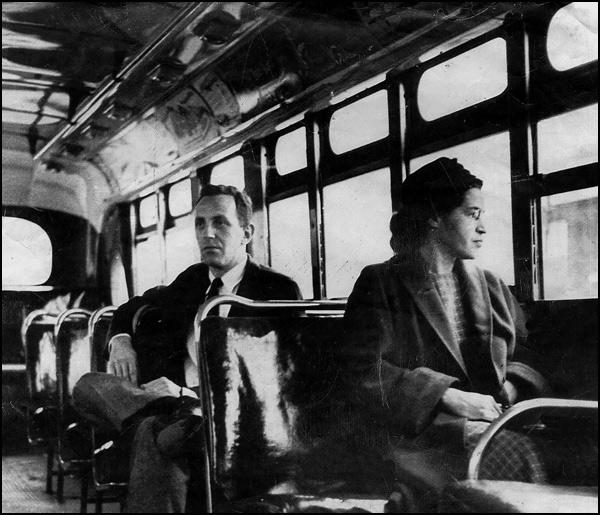
In Praise of Rosa Parks


A woman who truly inspired has passed away. From the Washington Post:
Parks said that she didn't fully realize what she was starting when she decided not to move on that Dec. 1, 1955, evening in Montgomery, Ala. It was a simple refusal, but her arrest and the resulting protests began the complex cultural struggle to legally guarantee equal rights to Americans of all races.

Within days, her arrest sparked a 380-day bus boycott, which led to a U.S. Supreme Court decision that desegregated her city's public transportation. Her arrest also triggered mass demonstrations, made the Rev. Martin Luther King Jr. famous, and transformed schools, workplaces and housing.

Hers was "an individual expression of a timeless longing for human dignity and freedom," King said in his book "Stride Toward Freedom."

"She was planted there by her personal sense of dignity and self-respect. She was anchored to that seat by the accumulated indignities of days gone and the boundless aspirations of generations yet unborn."

My first reaction was to ask, "Who will be the next Rosa Parks?" And then I realized it was a dumb question. We simply don't know, but everyone should audition for the part.

Blogsearch Technorati

Tuesday, September 20, 2005

In Praise of Simon Wiesenthal

Adam Bernstein has published an excellent article on the life of the Nazi Hunter in The Washington Post.

Simon Wiesenthal, 96, the controversial Nazi hunter who pursued hundreds of war criminals after World War II and was central to preserving the memory of the Holocaust for more than half a century, died early today at his home in Vienna, Austria. He had a kidney ailment.
I think this excerpt from the article captures him well:
He never doubted his motivation for working so long against the seemingly impossible odds of righting a genocide. In a New York Times article from 1964, he once described attending Sabbath services with a fellow camp survivors who had become wealthy jeweler. The man asked why Wiesenthal had not resumed architecture, his pre-war trade, for it would have made him rich.

"You're a religious man," Wiesenthal told his friend. "You believe in God and life after death. I also believe. When we come to the other world and meet the millions of Jews who died in the camps and they ask us, 'What have you done?' there will be many answers. You will say, 'I became a jeweler.' Another will say, 'I smuggled coffee and American cigarettes.' Another will say, 'I built houses.' But I will say, 'I didn't forget you.' "
And we won't forget him either. The Center that bears his name in California also has an extensive biography.

Bloogle this post

Sunday, August 14, 2005

Responding to Joe

Joe responds to my post in support of gay marriage by noting a part of Alfonso's original post that I left unaddressed:


That is a fair point, but it fails to address Alfonso's more potent argument (and the one he unfortunately seemed to stress less), which is that a man and woman close to one another in kinship cannot marry. To me, this is concrete, globally-accepted, and long-standing proof that we limit the definition of marriage at the expense of the happiness of an (admittedly small, but so is the homosexual set as a percentage) group of people. In this case, over a period of centuries we came to the conclusion that those who happen to fall in love with a relative ought not marry.

A brother and sister could theoretically have a long and joyous married life. Yet we forbid them to wed, and deny them that chance at happiness. Why? Forget religion; forget constitutionality. It is a decision that society has made in order to enforce a certain social order. In fact, we limit marriage to non-kin largely because of procreative and health issues, which is the chief reason many oppose gay marriage.

My argument does not stipulate that elected governments lack the authority to limit the definition of marriage at the expense of a small group of people. To be clear, I wrote:


Because I don't believe this is a constitutional issue, it is up to the states to define marriage and the legal privileges and responsibilities associated with it. Every state legislature should expand its definition of marriage to allow it to include two members of the same sex.
Holding the position that legislatures should exclude siblings from marrying while permitting same-sex marriages is not inconsistent. So the key question is the one Joe raises in his second paragraph above: against the loss of opportunity for potential members of same-sex couples, what would be the beneficial outcomes of not extending marriage to same-sex couples? Joe refers to procreative and health issues. I don't find either compelling as a reason to exclude homosexual unions in marriage given that the behavior is legal, but I haven't seen Joe's particular arguments.

Other blogs commenting on this post

Friday, August 12, 2005

In Support of Gay Marriage

Via Joe's Dartblog, I see that Alfonso Trujillo of HispanicPundit, one of my favorite bloggers, argues that gay marriage involves not just the same rights for homosexuals, but special rights:


Currently everybody already has the same rights with regard to marriage. You, homosexuals, heterosexuals, and me are all legally allowed to marry any person of the opposite sex of our choice who is distant from us in terms of kinship and who is not already married. Homosexuals have that very same right.

In other words, homosexuals as citizens of the United States have the same rights as I do. If a homosexual man wanted to marry a female who he is not related to, he could do so just as easily as I can. Homosexuals, as a group, are treated equally with regard to marriage as any other group.

“But gays are not allowed to marry the person they love”, you say. But that is the case with everybody. If I, as a male citizen of the United States fell in love with my sister, I would not be allowed to marry her. If I, as a male citizen of the United States fell in love with multiple women, I would be restricted to only marrying one. And just like gays, if I, as a citizen of the United States fell in love with another man, I too would be restricted in marrying him. In other words, gays, as citizens of the United States, have the same rights, and the same limitations, as everyone else.

Yes, that last statement is true. I do not believe this is a constitutional issue. But neither is it more than a semantic point that can be refuted simply by noting that homosexuals would not object to two heterosexual men marrying each other, either. They want these special rights for everyone.

And if you are a heterosexual man and think that prospect doesn't do much for your liberty as a citizen, then you now have some understanding of why this argument against gay marriage is so hollow. Because I don't believe this is a constitutional issue, it is up to the states to define marriage and the legal privileges and responsibilities associated with it. Every state legislature should expand its definition of marriage to allow it to include two members of the same sex.

What part of life, liberty, and the pursuit of happiness is enhanced for anyone by restricting the opportunities of homosexuals to participate in marriage in the same ways as heterosexuals? I do not believe that society is made better off when it goes out of its way to marginalize any group of people.

Besides, where's the wisdom in having laws that allow Britney Spears to marry the person of her choice but not Andrew Sullivan? I think I would have a much harder time explaining her public behavior to my kids than I would his private behavior.

Other blogs commenting on this post

Monday, July 04, 2005

Happy Independence Day

I agree with Tom Brokaw that, based on the contributions of ordinary people to an extraordinary event, the WWII generation deserves his honorific The Greatest Generation. Judged on the basis of the vision of the leaders, the honorific belongs to the Founders, and this is a day to remember them. To wit, the second paragraph of the Declaration of Independence:
We hold these truths to be self-evident, that all men are created equal, that they are endowed by their Creator with certain unalienable Rights, that among these are Life, Liberty and the pursuit of Happiness.--That to secure these rights, Governments are instituted among Men, deriving their just powers from the consent of the governed, --That whenever any Form of Government becomes destructive of these ends, it is the Right of the People to alter or to abolish it, and to institute new Government, laying its foundation on such principles and organizing its powers in such form, as to them shall seem most likely to effect their Safety and Happiness. Prudence, indeed, will dictate that Governments long established should not be changed for light and transient causes; and accordingly all experience hath shewn, that mankind are more disposed to suffer, while evils are sufferable, than to right themselves by abolishing the forms to which they are accustomed. But when a long train of abuses and usurpations, pursuing invariably the same Object evinces a design to reduce them under absolute Despotism, it is their right, it is their duty, to
throw off such Government, and to provide new Guards for their future security.--Such has been the patient sufferance of these Colonies; and such is now the necessity which constrains them to alter their former Systems of Government. The history of the present King of Great Britain is a history of repeated injuries and usurpations, all having in direct object the establishment of an absolute Tyranny over these States. To prove this, let Facts be submitted to a candid world.
They were right--on every assertion they made.

Other blogs commenting on this post

Tuesday, January 18, 2005

MLK at Dartmouth

Dartmouth celebrates Martin Luther King, Jr. each year with two weeks of programming. One of the activities is a continuous playing of a speech King made at Dartmouth in 1962, "Towards Freedom." You can read the transcript, watch the video, and read about the context for the speech here.


What I like about this speech is that it illustrates just how much King was a realist and an organizer, not just a dreamer. I thought these paragraphs were particularly lucid:


I would like to say first that the federal government must use all of its Constitutional authority to implement the law of the land. There is need for strong, forthright leadership from the federal government. If we look back over the last ten years, we must honestly admit that the kind of consistent, forthright leadership needed this hour has come only from the Judicial branch of the government. The Legislative and Executive branches have been all too silent, apathetic, and sometimes hypocritical. If this problem is to be solved, all branches of the government must work in a consistent, determined manner.


This means that we must get rid of two myths that often linger around. One is the myth of time. There are people who say that the federal government can't do anything about this problem. Only time can solve the problem. I'm sure that this argument continues to move around. There's the idea that if the Negro and his allies in the white community will just be patient and just wait, maybe in a hundred or two hundred years, time will solve the problem. Well the only answer that we have for those who have given themselves to the myth of time is that time is neutral. It can be used either destructively or constructively. At points I think that the people of ill will have used time more effectively than the people of goodwill. It may well be that we who have repented this generation not merely for the vitriolic words and actions of the bad people, but for the appalling silence of the good people, somewhere along the way of life we must come to see that human progress never rolls in on the wheels of inevitability.

Evolution may be true in the biological realm; and at this point Darwin is right. But when a Herbert Spencer seeks to apply to the whole of society, there is very little evidence for it. Human progress is construed of tireless efforts and the persistent work of dedicated individuals. Without this hard work, time itself becomes the ally of the insurgent and primitive forces of irrational emotionalism and social stagnation. We are always challenged to help time and to realize that the time is always right to do right.


There is another myth that tends to linger around and for lack of a better term I call it the myth of educational determinism. It is the idea that only education can solve the problems which we face in human relations, so there is no need to talk about

Executive Orders from the President of the United States or about legislation. It's only through the slow process of education and changing attitudes that this problem will be solved. Well, there's an element of truth in this because education does have a great role to play in changing attitudes. But this is a half-truth. It is not either legislation or education; it is both legislation and education. It may be true that morality cannot be legislated but behavior can be regulated. It may be true that the law cannot make a man love me; religion and education will have to do that. But if it keeps him from lynching me, and I think that's pretty important also.


It may be true that legislation cannot change the heart, but it can restrain the heartless. And this is what we often do through legislation. We must depend on education and religion to change bad internal attitudes, but we need legislation to control the external effects of those bad internal attitudes. So there is a need for civil rights legislation. And it is tragic indeed that in this session of Congress there will be no civil rights legislation. There's also need for Executive Orders from the President of the United States. There is a great deal the president can do with a stroke of the pen.

The speech also contains a thoughtful discussion of nonviolent resistance:

Then the Greek language has another word, the word "agape." Agape is more than aesthetic or romantic love, agape is more than friendship. Agape is understanding, creative, redemptive goodwill for all men. It is an overflowing love which seeks nothing in return. Theologians would say that it is the love of God operating in the human heart. When one arises to love on this level, he loves a person who does an evil deed while hating the deed the person does. And I believe that this kind of love will lead us through this period of transition, this kind of creating, understanding goodwill.


I think this is what Jesus of Nazareth meant when he said, "Love your enemies," and I'm so happy he didn't say, "Like your enemies," because it's pretty difficult to like some people. Like is a sentimental, affectionate sort of thing and it's difficult to like somebody who's bombing your home, and who's threatening your children, and who's throwing you in jail. It's difficult to like some of the senators and congressmen in Washington, the things they're saying about Negroes and members of other minority groups, and some of the things they are doing... It's difficult to like them and to like what they're doing, but Jesus said, "Love them," and love is greater than like. Love is understanding, creative, redemptive goodwill for all men. This is what

nonviolence says. It says that the love ethic is a possibility in the struggle for freedom and human dignity.

Enjoy!


Other blogs commenting on this post